Have you noticed that some letters in the Quran are held a little longer than others? Instead of a quick “Ba,” you stretch it into “Baa.” That small stretch is called Madd.
Madd in Tajweed is one of the first rules that makes your recitation smooth and correct. If you’ve already learned the Arabic alphabet and the short vowels in our Harakat lesson, you’re ready for it. Madd builds right on top of them.
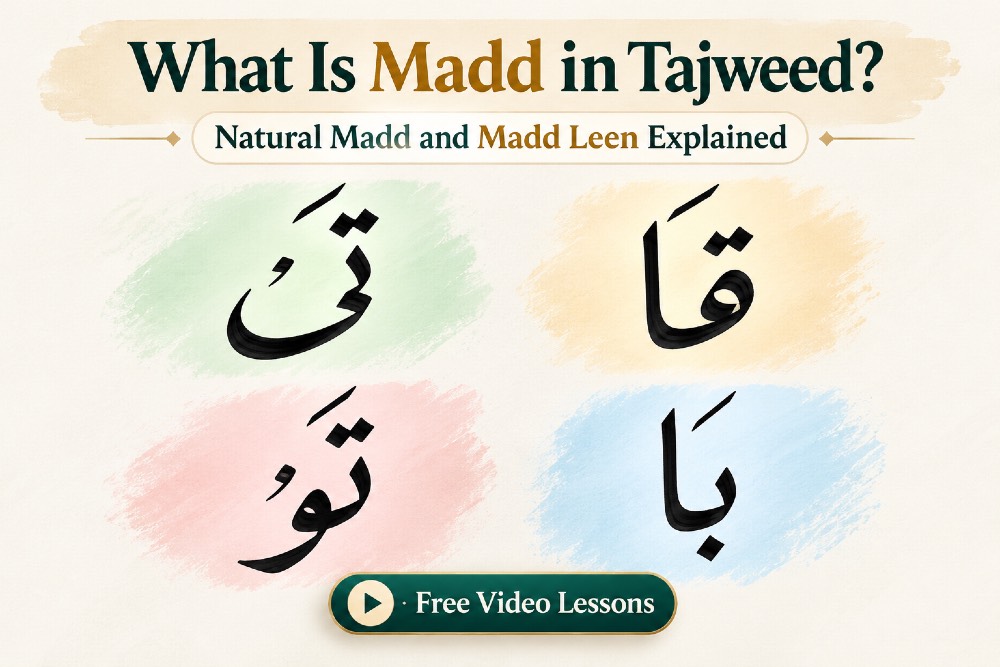
This Madd lesson starts with two types: Natural Madd and Madd Leen. You’ll learn how each one works, see them in real Quran words, and practice with free videos.
What Is Madd in Arabic?
Madd (مَدّ) means “to stretch” or “to lengthen.” You may also see it written as Mad or Madda. Same word.
In Tajweed, it means holding a vowel sound longer than usual. Think of it as a continuation of Harakat. Harakat in Tajweed are counted like beats, and Madd gives you more of them.
There are several types of Madd in the Quran. Here are the ones you’ll meet:
- Madd Tabeeiy (Natural Madd)
- Madd Leen
- Madd Muttasil
- Madd Munfasil
We’ll start with the first two. The rest come in later lessons.
Madd Tabeeiy (Natural Madd)
Madd Tabeeiy is the most common type of Madd. You may also see it written as Madd Tabee’i, Tabi’i, or Thabi’i. It’s called Natural Madd because it’s the normal way to lengthen a vowel.
Here’s the idea. One Harakah is one beat, like a single tap of your finger. Add a matching long vowel letter, and you hold the sound for two beats. That’s Natural Madd.
The Three Madd Letters in Arabic
Three letters create it, and you already know them from the Arabic alphabet:
- Alif (ا)
- Waw (و)
- Yaa (ي)
But you can’t put just any of these after any letter. Each one needs a matching short vowel before it:
- Fathah followed by Alif
- Dammah followed by Waw with Sukoon
- Kasrah followed by Yaa with Sukoon
The Alif of Madd has no vowel of its own.
Natural Madd Examples With Baa
Here is how one letter changes:
| Short sound (1 beat) | Add Madd letter | Long sound (2 beats) |
| بَ (Ba) | ا (Alif) | بَا (Baa) |
| بُ (Bu) | و (Waw) | بُو (Boo) |
| بِ (Bi) | ي (Yaa) | بِي (Bee) |
See the difference? Without Madd, you say “Ba,” a quick sound. With Madd, you say “Baa” and hold it for two Harakat. Bu and Bi work the same way. They become Boo and Bee.
How Long Are Two Harakat?
It’s not a fixed number of seconds. Two Harakat means about twice as long as one short vowel, at your normal recitation speed.
To practice, count two gentle beats while you say Baa, Boo, and Bee. Keep the timing steady. Don’t rush, and don’t drag it out.
Watch this video to hear how Madd Tabeeiy (Natural Madd) sounds.
Madd in Quran Examples
So far you’ve practiced with single letters. In the Quran, these sounds sit inside full words. Here are three examples:
| Quranic word | Madd sound | Madd letter |
| قَالَ | Qaa | Alif |
| يَقُولُ | Qoo | Waw |
| قِيلَ | Qee | Yaa |
In each word, the matching Madd letter stretches the vowel. You may also see a small upright Alif in the Quran. It marks a long “aa” sound too. Don’t worry if the markings look new. They get familiar with practice.
Watch this video to practice Natural Madd in Quran words. Notice the vowel before each Madd letter, and how the sound stretches.
Two Things to Remember
1. Not every Alif is a Madd letter. In some words, like آمَنُوا, an Alif is written after the Waw but isn’t pronounced. You stretch the sound with the Waw only. This is a spelling feature of Arabic.
2. Keep the stretch in your mouth. The sounds of Meem and Noon partly use the nose. But when you stretch a Madd sound on them, it should come from the mouth. No nasal sound needed here.
What Is Madd Leen?
Madd Leen is the second type. You may see it written as Madd Al-Leen or Madd Lin. In Arabic, Leen means softness. So you can call it a soft Madd.
It looks like Natural Madd, but the rule is different. In Natural Madd, Waw follows Dammah and Yaa follows Kasrah. In Madd Leen, both Waw and Yaa follow a Fathah instead.
Madd Leen involves two letters:
- Waw with Sukoon (وْ)
- Yaa with Sukoon (يْ)
In both cases, the letter before has a Fathah. Here is how that sounds:
| Letters | Sound |
| تَوْ | Taw |
| تَيْ | Tay |
Taw is close to the “ow” in “now.” Tay is close to the “ay” in “day.” These aren’t the long “oo” and “ee” of Natural Madd. Your mouth glides softly from the “a” toward the “w” or “y.”
When Do We Stretch Madd Leen?
Here is the big difference from Natural Madd.
If you keep reading, you say the soft sound normally, with no extra stretch. When you stop on the word, the Leen sound can be held for 2, 4, or 6 Harakat. These lengths are permitted in the commonly taught Hafs recitation. Your teacher will tell you which one to follow. Pick one and stay consistent.
You don’t need to master all three today. First, learn to spot the Leen letters and say them correctly.
Madd Leen Examples in the Quran
Two words from Surah Quraysh show it clearly:
- خَوْفٍ (Khawf) in Surah Quraysh, 106:4. The Waw has Sukoon, and the letter before it has a Fathah.
- الْبَيْتِ (Al-Bayt) in Surah Quraysh, 106:3. The Yaa has Sukoon, and the letter before it has a Fathah.
When you stop on these words, the Madd Leen rule applies. Also, keep heavy letters heavy and light letters light, just as you learned in the alphabet lesson.
Watch this video to learn Madd Leen and practice the examples.
Natural Madd vs Madd Leen
Here is how the two compare:
| Natural Madd | Madd Leen | |
| Letters | Alif, Waw, Yaa | Waw, Yaa |
| Vowel before the letter | Fathah, Dammah, Kasrah | Fathah only |
| Sound | Long vowel | Soft glide |
| Length | 2 Harakat | 2, 4, or 6 when stopping |
| Examples | بَا، بُو، بِي | خَوْف، بَيْت |
An easy way to remember: Natural Madd gives you a long vowel. Madd Leen gives you a soft glide that can be stretched when you stop.
Practice Natural Madd and Madd Leen Together
These two Madds show up all the time in the Quran. The best way to get comfortable is to practice with real words.
In this video, you’ll practice both. Try reading each example first, then listen, then repeat and compare your sound.
It’s fine if it takes a few tries. Spotting the rule comes first. A clean sound comes with practice.
Other Types of Madd in Tajweed
Natural Madd and Madd Leen are only part of the story. As you go on, you’ll meet:
- Madd Muttasil (also written Madd e Muttasil): a Madd letter followed by Hamzah in the same word
- Madd Munfasil (also written Madd e Munfasil): a Madd letter at the end of one word, with Hamzah starting the next
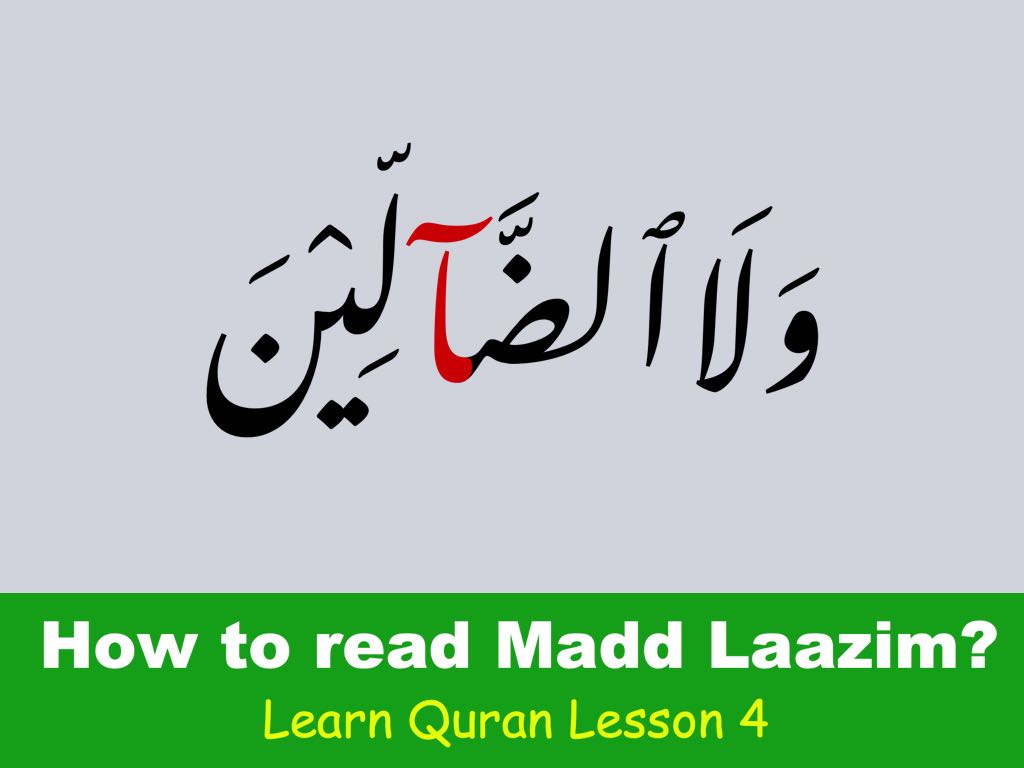
- Madd Lazim: a Madd letter followed by a permanent Sukoon or Shaddah
- Madd Arid lis-Sukoon: a stretch that happens when you stop on a word
Some of these are longer, often 4 or 5 Harakat. Each gets its own lesson so you can learn it properly without mixing things up.
What You’ve Covered
You now know how to:
- Explain what Madd means in Arabic and Tajweed
- Spot Natural Madd and hold it for two Harakat
- Recognize Madd Leen and when it stretches
Before you move on to Tajweed rules, practice Harakat, Tanween, and Madd together in the Quran with our practice exercises.
Frequently Asked Questions About Madd
What is Madd in the Quran?
It’s the rule that tells you to hold a vowel sound longer while reciting. It keeps your recitation smooth and accurate, and it comes in several types.
What is Madda in Arabic?
Madda is another spelling of Madd. Both mean “stretching” or “lengthening.”
What is the difference between Harakat and Madd?
Harakat (Fathah, Dammah, and Kasrah) give a letter a short vowel sound. Madd lengthens that vowel. Natural Madd lasts two Harakat.
How many letters of Madd are there?
Three: Alif, Waw, and Yaa. Each one needs the right short vowel before it.
What is Madd Lazim?
Madd Lazim happens when a Madd letter is followed by a permanent Sukoon or Shaddah. It’s one of the longer types, and it has its own lesson.
Do I need to know Harakat before learning Madd?
Yes, a little. Madd stretches the short vowels, so it helps to be comfortable with Fathah, Dammah, and Kasrah first. If you need a refresher, start with the Harakat lesson.
Credit: These video tutorials were created by Imam Hassan Raza and shared here with his permission. I organized them into this series so you can learn at your own pace.