Opening the Quran for the first time can feel like looking at a beautiful painting you can’t read yet. The letters look unfamiliar, and you may not know where to begin.
Here is the good news. Every Quran reader started right where you are. They learned to:
- Recognize the letters
- Hear the sounds
- Practice a little each day
That’s it.
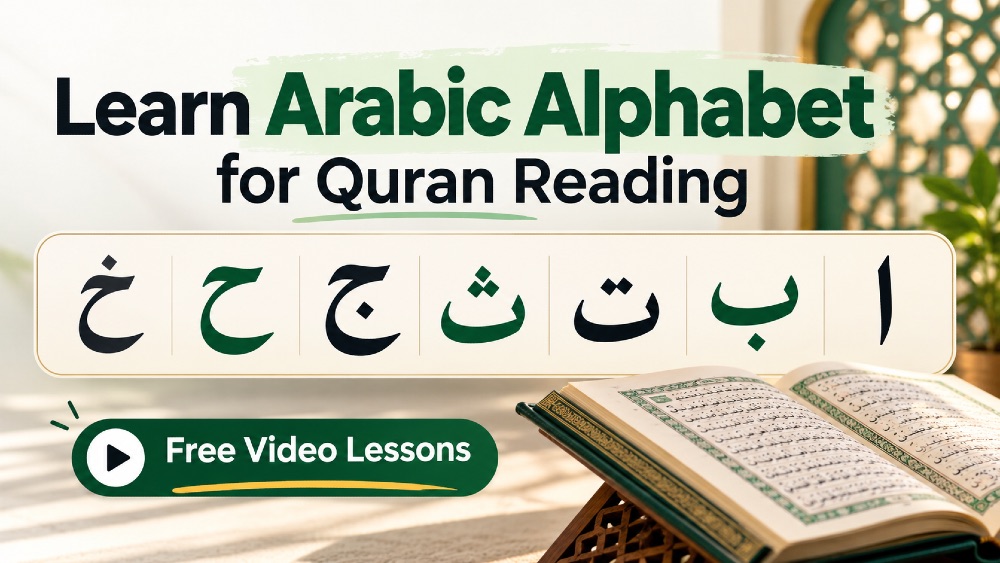
Want to learn the Arabic alphabet? You’re in the right place. Below are short video lessons on letter recognition, pronunciation, Makharij, and how letters connect to form Quran words.
Start with the Arabic alphabet chart below. These are the same letters you’ll see on every page of the Quran.
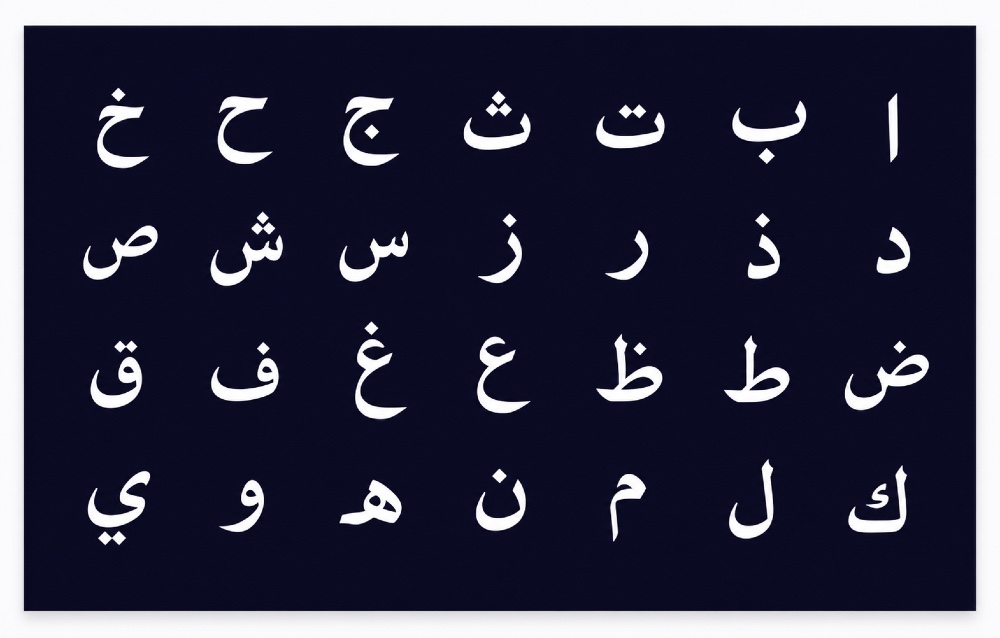
The Arabic Alphabet Used in the Quran
The Arabic alphabet has 28 letters, or 29 if you count Hamza. Every word in the Quran is built from these Arabic letters, so this is your foundation for Quran reading.
You don’t need to memorize the whole chart today. Just let your eyes get used to the shapes. Familiarity comes first, and memory follows on its own.
Lesson 1: Learn Arabic Letters and Their Sounds
Every letter has its own sound. A few are close to English. Others will feel brand new, and that’s completely normal.
For now, keep your goal small. Focus on two things:
- Recognizing the shape of each letter
- Learning its basic pronunciation
The videos below split the Quran alphabet into four small groups. That way you never have to swallow all 29 letters at once.
Think of these lessons as a free Arabic alphabet course you can finish at your own pace. Watch one, repeat it out loud, then move on.
Video 1: Alif to Khaw
This is your first group of letters. Look closely at each shape and say each sound a few times. Speaking out loud matters here. Your mouth needs practice, not just your eyes.
Video 2: Daal to Da’awd
Now you’ll start noticing that some letters sound almost the same. That’s a good sign. It means your ear is waking up. Catching these small differences early will save you from common Arabic alphabet pronunciation mistakes later.
Repeat each letter aloud before you move on.
Video 3: Ta’aw to Kaaf
This group trips up a lot of beginners. Several letters here have a deeper, heavier sound that English doesn’t have. If they feel awkward, you’re not doing anything wrong.
Listen closely, copy what you hear, and come back to this video a few times. These sounds get easier with repetition, not with pressure.
Video 4: La’am to Yaa
This is the last group. Once you finish it, you’ll be able to recognize every one of the letters in the Quran. That’s a real milestone, so take a moment to enjoy it.
Next up are Makharij, connecting letters, and Harakat.
Two Things That Make Arabic Letter Pronunciation Easier
Before you go further, two small ideas will make everything ahead feel less confusing.
Some Letters Sound Heavier Than Others
Think of Quranic letters as light or heavy. Light letters sound thin and bright. Heavy letters sound fuller and rounder, as if your mouth is making more room for the sound.
Seven letters are always heavy. They are:
- خ (Khaw)
- ص (Sa’awd)
- ض (Da’awd)
- ط (Taaw)
- ظ (Zaaw)
- غ (Ghayn)
- ق (Qaaf)
The letter ر (Raa) can go either way depending on the word.
You don’t need to memorize this list today. Just know that if a letter feels different in your mouth, there’s a reason. Your tongue sits in a slightly different spot, and you’ll get used to it with practice.
Alif Works Differently From Most Letters
Alif (ا) is a bit of a special one. In most cases it doesn’t make a full sound by itself. It doesn’t have a sound of its own. Instead, it stretches the sound of another letter.
Here’s an easy example. When you say the names Baa, Taa, or Saa, that long “aa” at the end comes from Alif.
You’ll see more of this when you learn Harakat and Arabic vowel sounds. For now, just remember that Alif is a helper that lengthens sounds.
Lesson 2: Learn Makharij of Arabic Letters
Every Quranic Arabic letter has a home. That home is the spot in your mouth or throat where its sound begins. It’s called a Makhraj. The plural is Makharij, also known as the place of articulation.
Once you know a letter’s Makhraj, you know where the sound should come from: your throat, tongue, lips, or nose.
Learning Makharij helps you:
- Pronounce Arabic letters correctly
- Stop mixing up letters that sound alike
- Read and recite the Quran with more confidence
- Build a solid base for Tajweed
As you watch the lesson below, try this. Say each sound slowly and notice what your tongue, throat, and lips are doing. A small mirror can help.
The 9 Main Makharij Groups
Teachers often sort Arabic letters by where their sounds come from. It makes Arabic alphabet pronunciation much easier to learn. Here is a simplified overview for beginners.
1. Letters from the lips
Examples: ف (Faa), ب (Baa), م (Meem), و (Waw)
Your lips do most of the work here.
2. Letters from the root of the upper teeth
Examples: ت (Taa), د (Daal), ط (Taa, the heavy one)
The tip of your tongue touches the area just behind the upper teeth.
3. Letters from the edge of the upper teeth
Examples: ث (Thaa), ذ (Dhaal), ظ (Zaa)
Bring your tongue close to the upper teeth, and these sounds come out.
4. Letters from the middle of the tongue
Examples: ج (Jeem), ش (Sheen), ي (Yaa)
The middle of your tongue lifts toward the roof of your mouth.
5. Letters from the middle of the throat
Examples: ح (Haa), ع (Ayn)
These sounds feel new to many English speakers because they come from deeper in the throat.
6. Letters from the back of the tongue
Examples: خ (Kha’aw), غ (Ghayn)
You make these sounds toward the back of the mouth.
7. Letters from the front of the upper palate
Examples: ل (Laam), ن (Noon), ر (Raa)
These letters share a nearby spot, but each one still has its own sound.
8. Letters from between the tongue and teeth
Examples: س (Seen), ز (Zay), ص (Sa’awd)
Air slips through a narrow gap between your tongue and teeth.
9. Letters from the lower throat
Examples: ء (Hamza), ه (Haa)
These sounds start deep in the throat.
Learning Makharij isn’t meant to make reading the Quran harder. It’s otherwise. Once you know where each Arabic letter comes from, you understand why it sounds the way it does, and that makes your Quran recitation and Tajweed much easier later.
Lesson 3: How to Read Arabic Letters When They Connect
So far, you’ve seen each letter standing alone. But open the Quran and you’ll hardly find any letters sitting by themselves. They’re joined together to form words.
This is the point where many beginners feel stuck. If that’s you, relax. Arabic writing follows clear patterns, and once you spot them, learning how to read Arabic letters gets much easier.
Here’s the one thing to understand. A letter can change its shape depending on where it sits in a word. It can appear:
- At the beginning of a word
- In the middle of a word
- At the end of a word
- On its own
Take Baa as an example. It looks like ب on its own, بـ at the start, ـبـ in the middle, and ـب at the end. The shape shifts a little, but it’s still Baa.
Watch the lessons below and focus on how each letter changes and how it joins its neighbors. After a while, you’ll stop seeing separate shapes and start seeing whole words.
Connected Letters, Part 1
This lesson covers the basic rules of joining letters. Pay attention to the beginning and middle forms. You’ll see them again and again in the Quran.
Connected Letters, Part 2
Now you’ll practice more combinations. This lesson helps you spot letters in different positions and get comfortable with common joining patterns.
Connected Letters Practice
Time to put it all together. Pause the video, try each one yourself, then check your answer.
Frequently Asked Questions About Learning the Arabic Alphabet
How many Arabic letters are there?
The Arabic alphabet has 28 letters, or 29 if you count Hamza. That’s also the answer if you’ve wondered how many letters are in the Arabic language. These are the same letters used in the Quran, and every Quranic word is built from them.
What are the letters of the Quran called?
They’re simply called Arabic letters, or Huroof in Arabic. People also say Quran letters, Quranic letters, or the Quran alphabet. It all points to the same 28 letters, plus Hamza.
Is the Quran alphabet different from the Arabic alphabet?
No, they’re the same. When people say “Quranic alphabet” or “letters in Quran,” they simply mean the Arabic letters used in the Quran. Some people also search for these as Islamic letters, but they are just the Arabic alphabet. The big focus for Quran learners is pronouncing them correctly so recitation stays accurate.
How can I learn the Arabic alphabet online?
Start with free video lessons, like the ones on this page. Watch a short lesson, say each letter out loud, and repeat it the next day. If you ever want more guidance, an Arabic alphabet course online with a teacher can help you fix pronunciation early. Either way, daily practice matters more than the platform.
How do I learn the Arabic alphabet as a beginner?
Take it in small pieces. Learn the shapes first, then the sounds, then Makharij, and finally connected letters. Video lessons help a lot because you can hear the correct pronunciation and replay it as often as you like.
Is there a free Arabic alphabet course?
Yes. Free alphabet charts, pronunciation guides, and video lessons are easy to find. The lessons on this page are made for complete beginners, so you don’t need any Arabic background to start.
How long does it take to learn the Arabic alphabet?
Most beginners can recognize the letters within a few weeks of regular practice. Pronouncing them well and reading smoothly takes longer. The good news is that steady daily practice usually shows results faster than people expect.
What are Makharij and why do they matter?
Makharij are the places where Arabic sounds come from, such as the lips, tongue, or the throat. Knowing them helps you pronounce letters correctly and gets you ready for Tajweed and proper Quran recitation.
Do I need Tajweed before learning the Arabic alphabet?
No. Arabic letters come first. Get comfortable with recognizing and pronouncing them, and with reading simple words. After that, Tajweed rules make much more sense.
What comes after learning the Arabic alphabet?
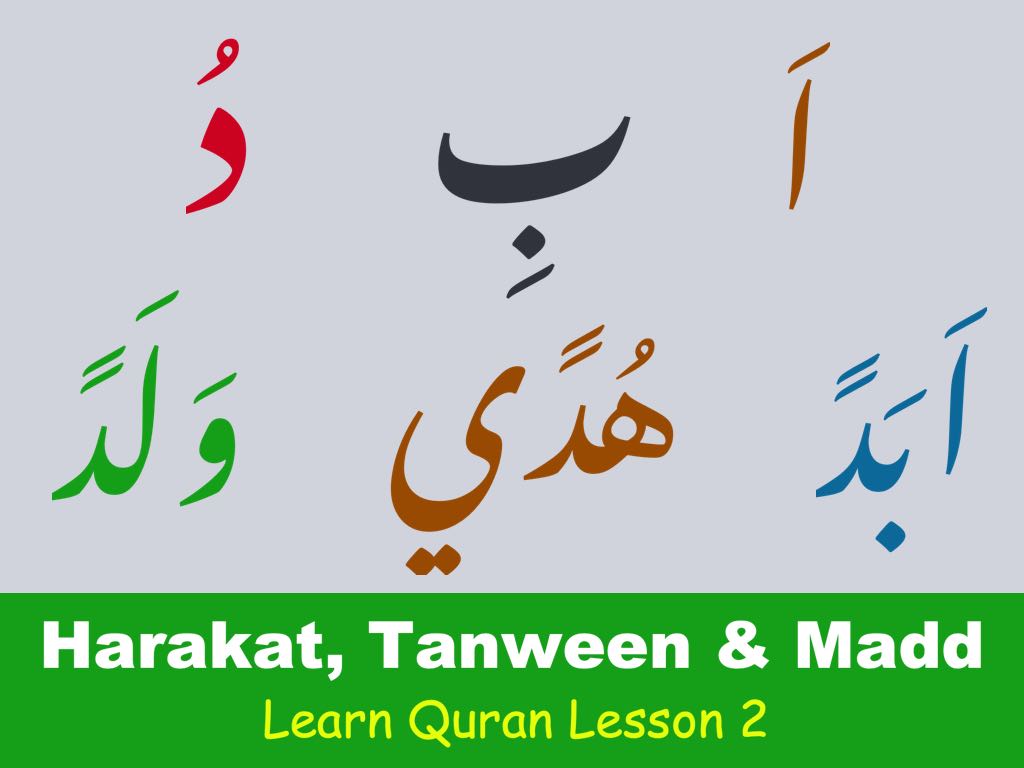
Harakat, the Arabic vowel marks, come next. After that, you’ll practice connected letters, simple words, and eventually full verses. Tajweed gets added gradually as your reading improves.
Can adults learn the Arabic alphabet?
Absolutely. Plenty of people start as adults and go on to read the Quran well. Adults often do great because they like having a clear plan and understanding why each step matters.
Do I need to know Arabic to read the Quran?
No. You don’t have to speak Arabic to learn to read the Quran. Many Muslims around the world read it without Arabic being their first language. If you learn the letters, the sounds, and the reading rules, your confidence will grow with time.
Why do some Arabic letters sound so similar?
To a beginner’s ear, some letters seem alike because they share certain qualities. But each one has its own Makhraj and its own sound. With careful listening and practice, the differences start to stand out.
Is it normal to struggle with Arabic pronunciation at first?
Yes, completely. Many Arabic sounds don’t exist in English, so your mouth has to learn new moves. Ayn, Haa, Khaa, Ghayn, and Qaaf usually need extra practice. Keep repeating them and they will feel more natural.
These video tutorials were created by Imam Hassan Raza and shared here with his permission. I organized them into this series so you can learn at your own pace.
You are a great teacher! Thanks a lot for your videos. The way you explain everything makes it much easier to get the sounds right.
Good content!!